History of the Family
The family history was presented at the 2016 reunion as sixteen panels, written in Portuguese. The panels are reproduced here as they were, each followed by its text in English.
01 — Italy
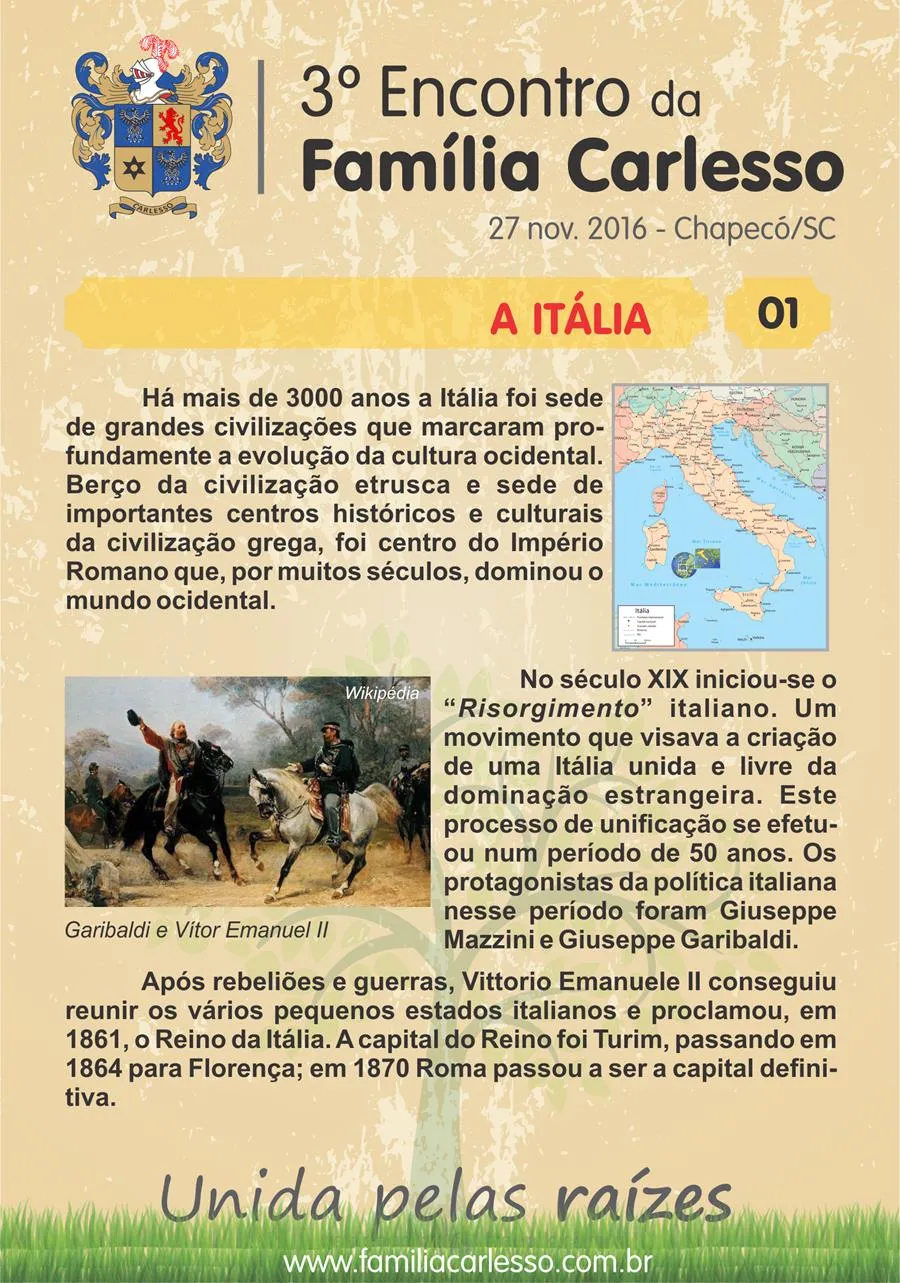
For more than 3,000 years Italy was home to great civilisations that left a deep mark on the development of Western culture. Cradle of the Etruscan civilisation and home to important historical and cultural centres of Greek civilisation, it was the heart of the Roman Empire, which for many centuries dominated the Western world.
In the 19th century the Italian Risorgimento began, a movement seeking an Italy united and free of foreign rule. Unification took place over some fifty years. The leading figures of Italian politics in that period were Giuseppe Mazzini and Giuseppe Garibaldi.
After rebellions and wars, Vittorio Emanuele II managed to bring together the various small Italian states and proclaimed the Kingdom of Italy in 1861. The capital was Turin, moving to Florence in 1864; in 1870 Rome became the definitive capital.
02 — The Veneto
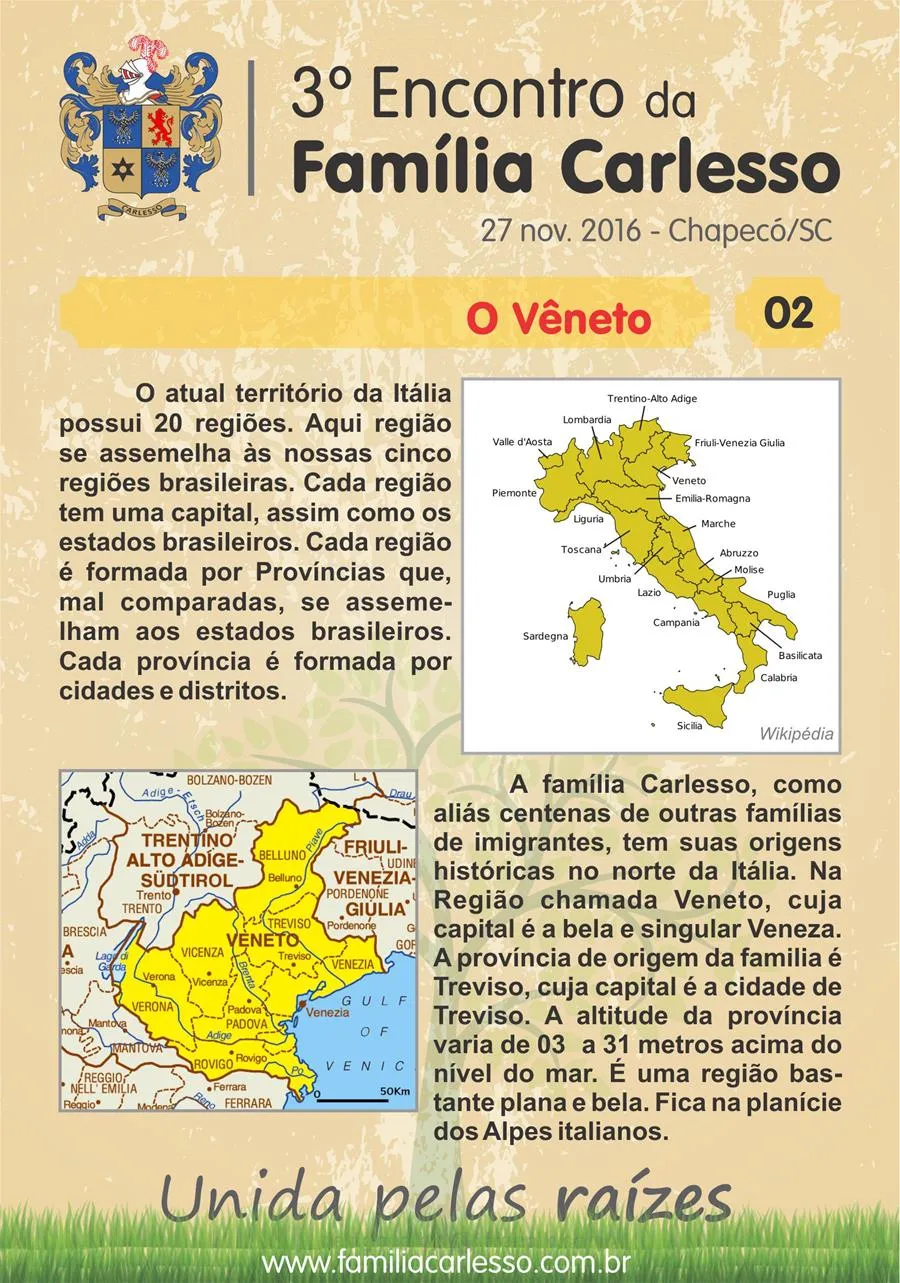
Italy today has 20 regions. A region there is much like one of our five Brazilian regions. Each region has a capital, as Brazilian states do, and each is made up of Provinces which, loosely compared, resemble Brazilian states. Each province is made up of towns and districts.
The Carlesso family, like hundreds of other immigrant families, has its historical origins in northern Italy, in the region called Veneto, whose capital is the beautiful and singular Venice. The family's province of origin is Treviso, whose capital is the city of Treviso. The province lies between 3 and 31 metres above sea level. It is a very flat and beautiful region, on the plain below the Italian Alps.
03 — The Lion of St Mark
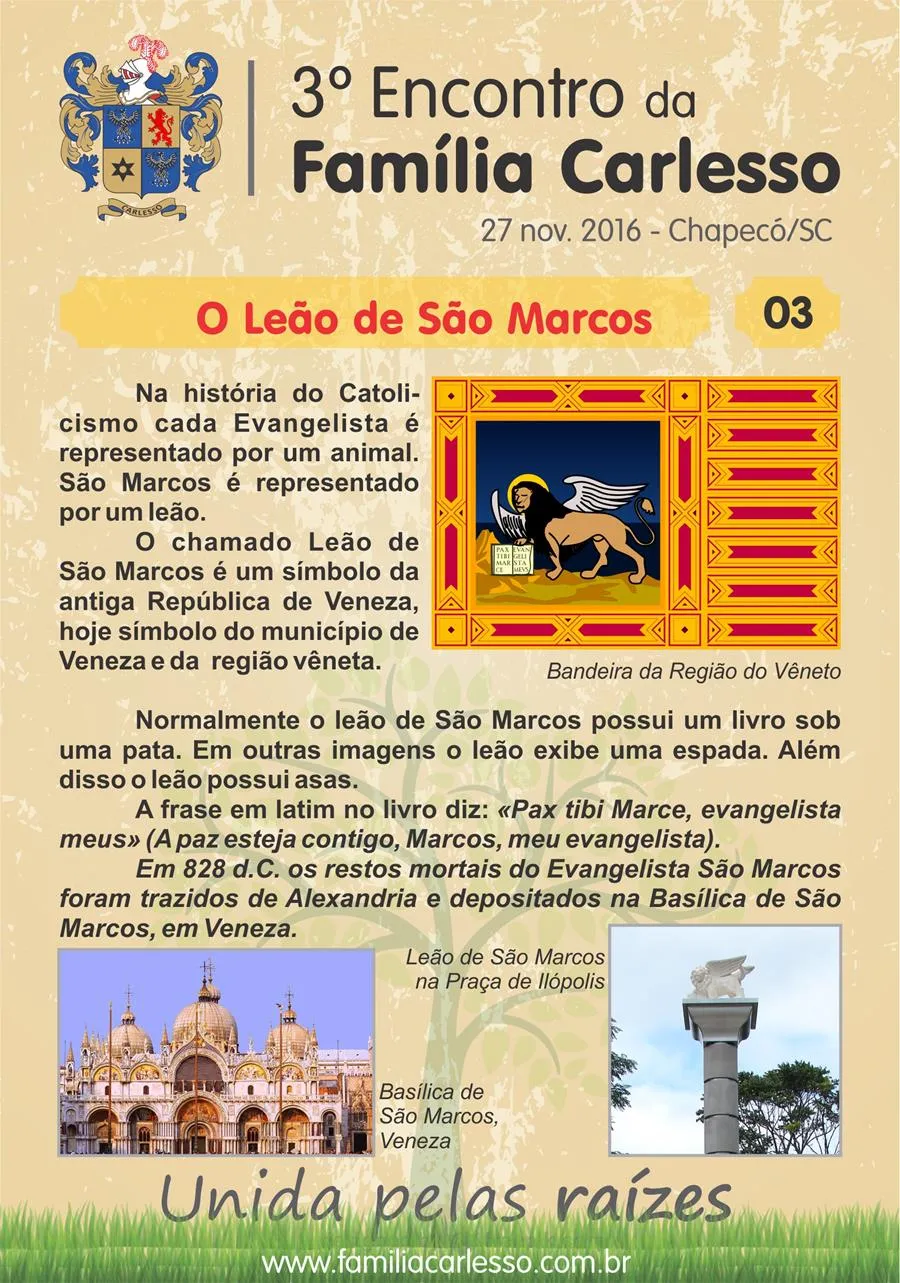
In the history of Catholicism each Evangelist is represented by an animal. St Mark is represented by a lion.
The Lion of St Mark was a symbol of the old Republic of Venice, and is today the symbol of the municipality of Venice and of the Veneto region.
The lion of St Mark usually holds a book under one paw. In other images it carries a sword. The lion also has wings. The Latin phrase in the book reads «Pax tibi Marce, evangelista meus» (Peace be with you, Mark, my evangelist).
In 828 AD the remains of the Evangelist St Mark were brought from Alexandria and laid in St Mark's Basilica, in Venice.
04 — The comune of Loria
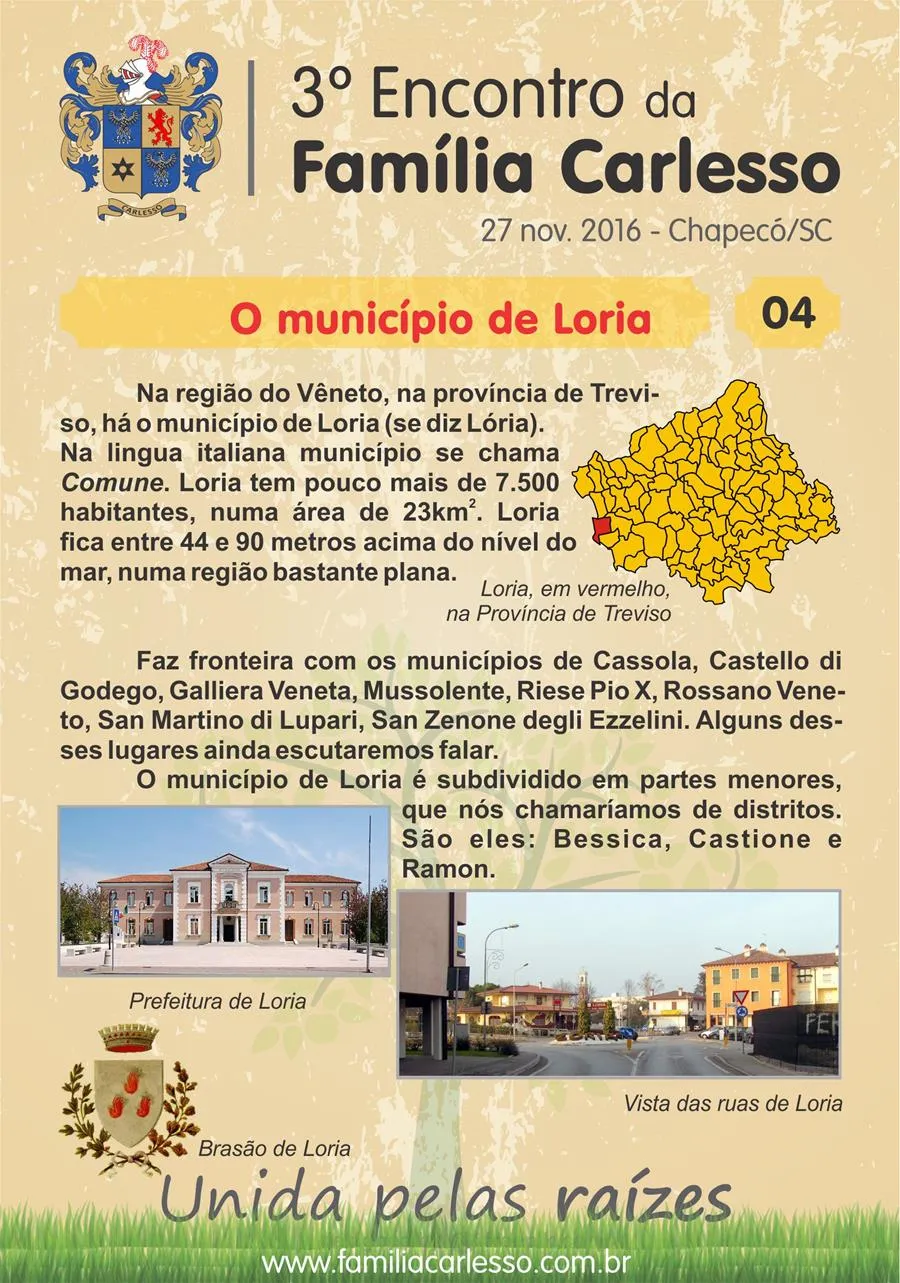
In the Veneto region, in the province of Treviso, lies the comune of Loria (pronounced Lória). In Italian a municipality is called a Comune. Loria has a little over 7,500 inhabitants in an area of 23 km². It lies between 44 and 90 metres above sea level, in very flat country.
It borders the comuni of Cassola, Castello di Godego, Galliera Veneta, Mussolente, Riese Pio X, Rossano Veneto, San Martino di Lupari and San Zenone degli Ezzelini. Some of these places we will hear of again.
The comune of Loria is divided into smaller parts, which we would call districts: Bessica, Castione and Ramon.
05 — Bessica di Loria
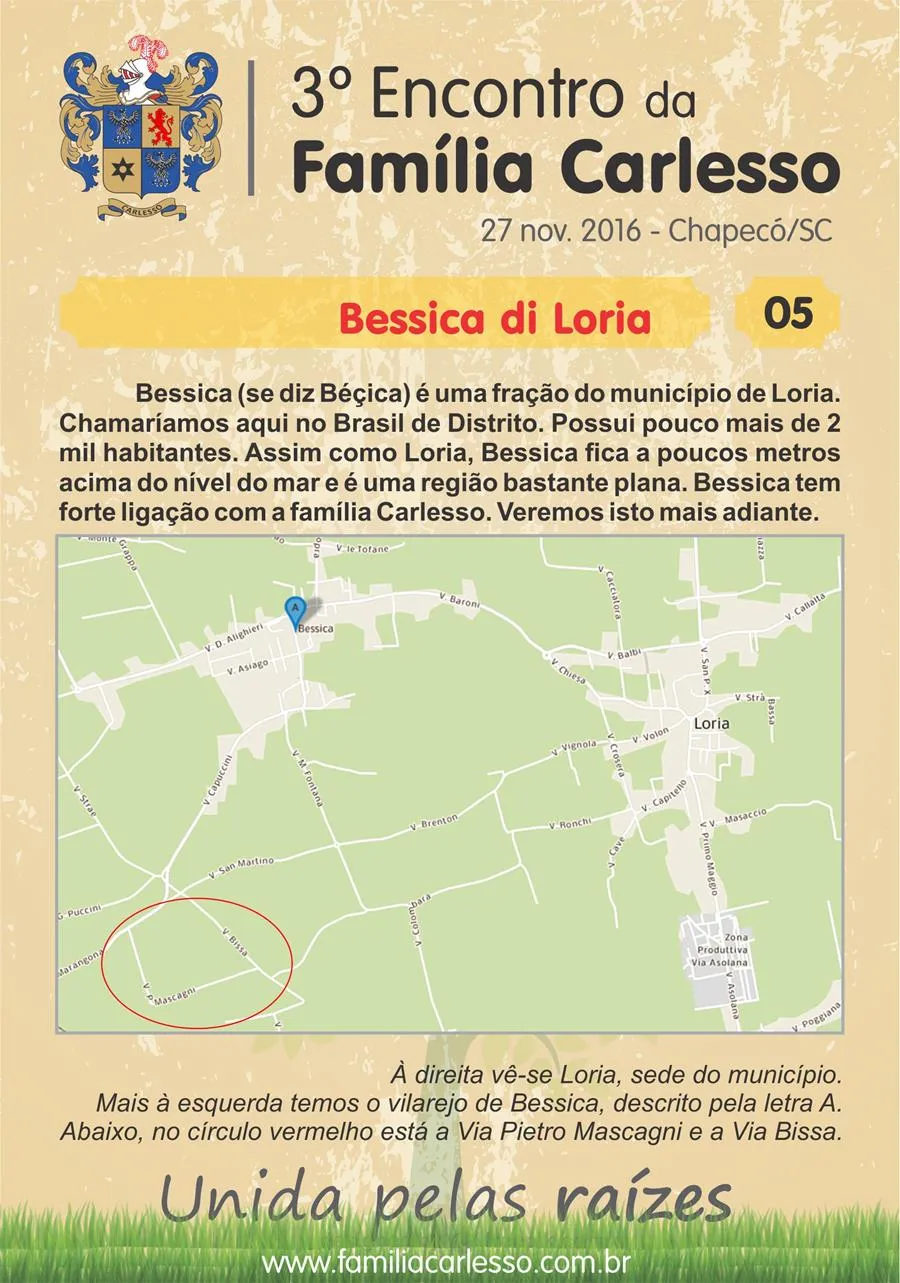
Bessica (pronounced Béçica) is a frazione of the comune of Loria; here in Brazil we would call it a district. It has a little over 2,000 inhabitants. Like Loria, Bessica lies a few metres above sea level and is very flat. Bessica has a strong connection with the Carlesso family, as we shall see.
On the right of the map is Loria, the seat of the comune. Further to the left is the village of Bessica, marked with the letter A. Below, in the red circle, are Via Pietro Mascagni and Via Bissa.
06 — The family in Bessica, part 1
As we said, Bessica is a frazione of the comune of Loria.
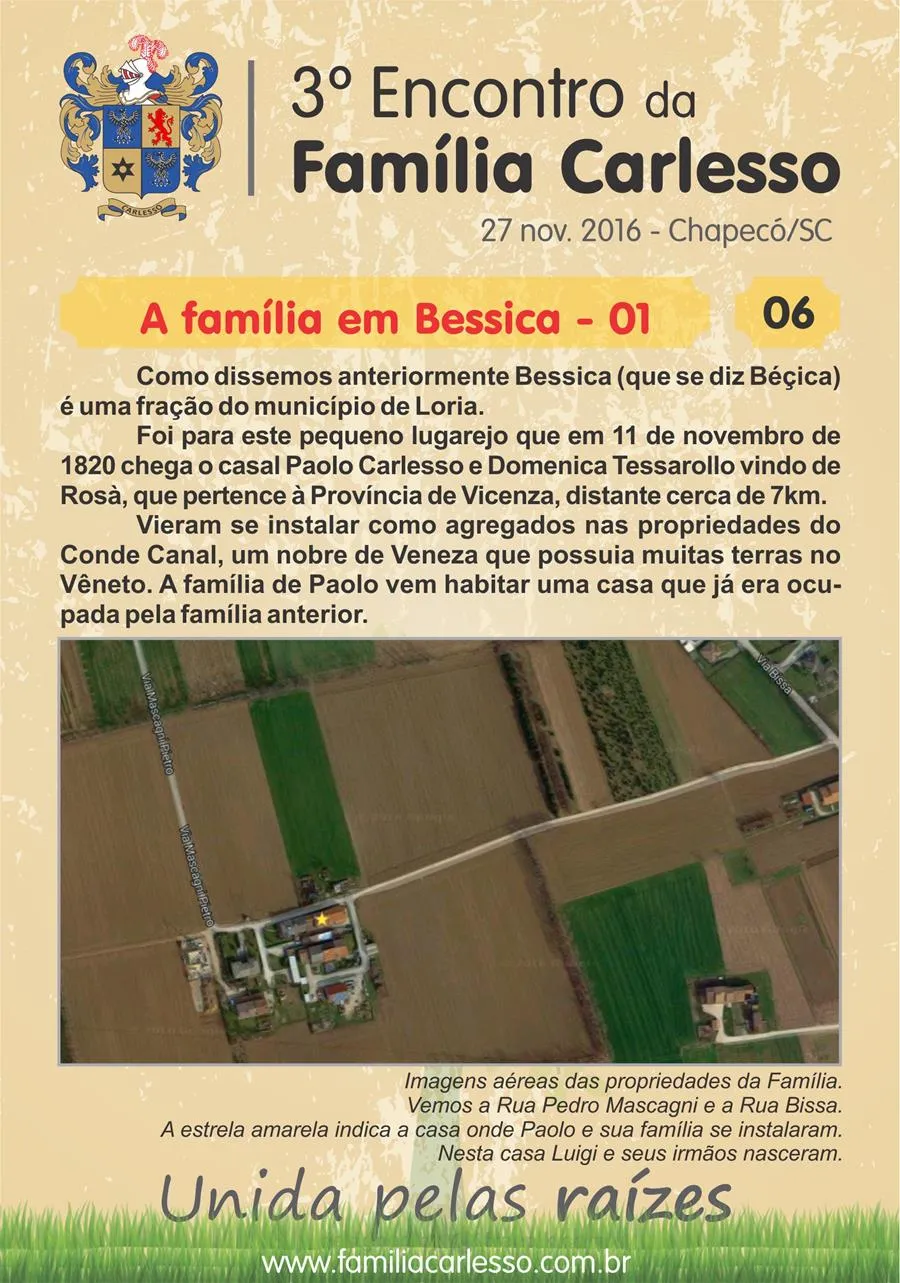
It was to this small place that, on 11 November 1820, Paolo Carlesso and Domenica Tessarollo came from Rosà, in the Province of Vicenza, some 7 km away.
They settled as tenants on the properties of Conde Canal, a Venetian nobleman who owned a great deal of land in the Veneto. Paolo's family came to live in a house that a previous family had occupied.
Aerial view of the family's land, showing Via Pedro Mascagni and Via Bissa. The yellow star marks the house where Paolo and his family settled. Luigi and his brothers were born in this house.
07 — The family in Bessica, part 2
Paolo and his family received land amounting to 33 campi (1 campo trevisano = 5,000 m²), that is, 16.5 hectares.
Coming from Rosà with Paolo and Domenica were their children Giacomo, Girolamo, Orsola, Bernardo and Angela, all born in Rosà. Later, in Bessica, Francesco and Andrea were born. Andrea would become Luigi's father.
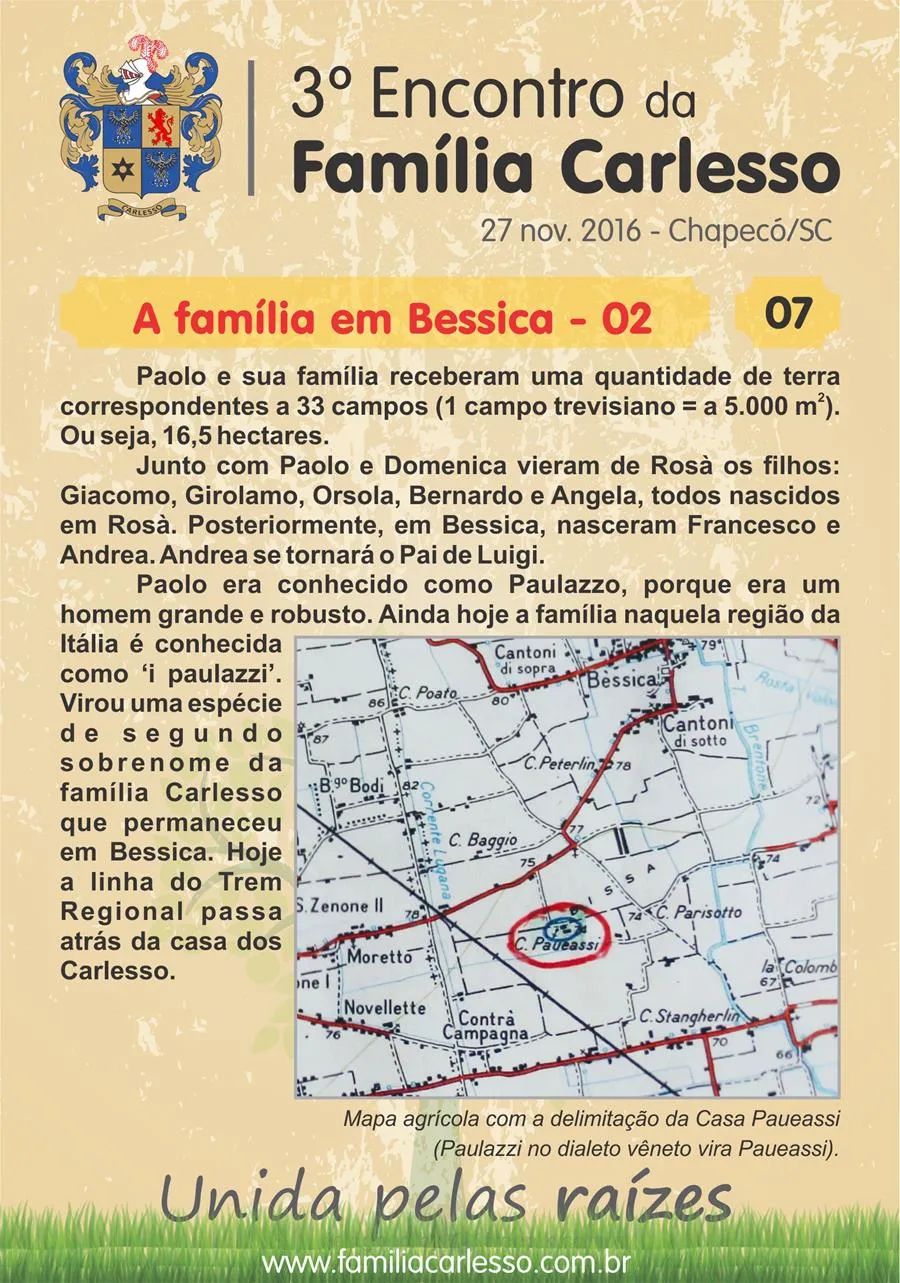
Paolo was known as Paulazzo, because he was a big, sturdy man. To this day the family in that part of Italy is known as 'i paulazzi'. It became a kind of second surname for the Carlesso family that stayed in Bessica. Today the regional railway line runs behind the Carlesso house.
An agricultural map showing the boundary of the Casa Paueassi (Paulazzi becomes Paueassi in the Venetian dialect).
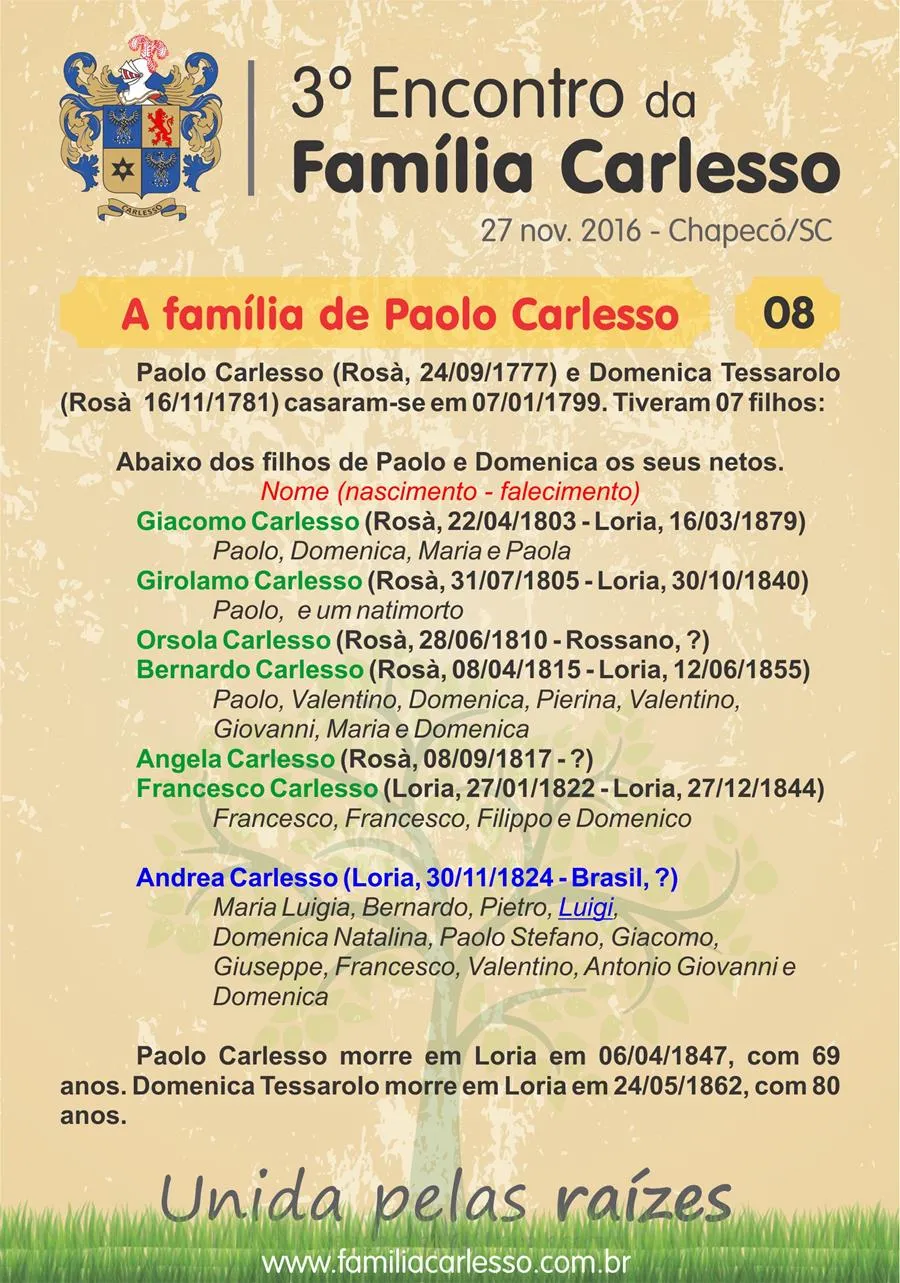
08 — The family of Paolo Carlesso
Paolo Carlesso (Rosà, 24/09/1777) and Domenica Tessarolo (Rosà, 16/11/1781) married on 07/01/1799. They had seven children. Beneath each of Paolo and Domenica's children are their own children.
Name (birth – death)
- Giacomo Carlesso (Rosà, 22/04/1803 – Loria, 16/03/1879) — Paolo, Domenica, Maria and Paola
- Girolamo Carlesso (Rosà, 31/07/1805 – Loria, 30/10/1840) — Paolo, and one stillborn child
- Orsola Carlesso (Rosà, 28/06/1810 – Rossano, ?)
- Bernardo Carlesso (Rosà, 08/04/1815 – Loria, 12/06/1855) — Paolo, Valentino, Domenica, Pierina, Valentino, Giovanni, Maria and Domenica
- Angela Carlesso (Rosà, 08/09/1817 – ?)
- Francesco Carlesso (Loria, 27/01/1822 – Loria, 27/12/1844) — Francesco, Francesco, Filippo and Domenico
- Andrea Carlesso (Loria, 30/11/1824 – Brazil, ?) — Maria Luigia, Bernardo, Pietro, Luigi, Domenica Natalina, Paolo Stefano, Giacomo, Giuseppe, Francesco, Valentino, Antonio Giovanni and Domenica
Paolo Carlesso died in Loria on 06/04/1847, aged 69. Domenica Tessarolo died in Loria on 24/05/1862, aged 80.
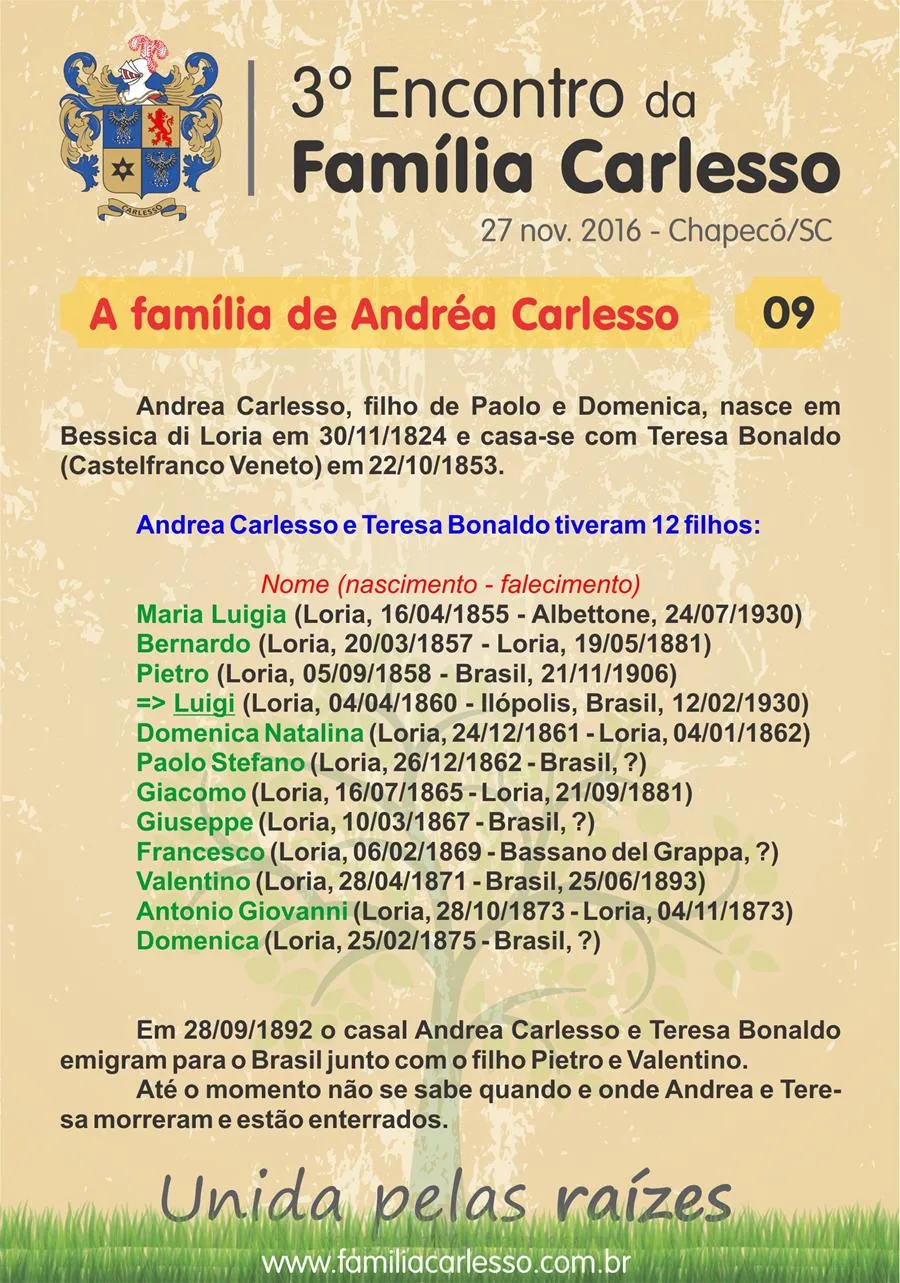
09 — The family of Andrea Carlesso
Andrea Carlesso, son of Paolo and Domenica, was born in Bessica di Loria on 30/11/1824 and married Teresa Bonaldo (Castelfranco Veneto) on 22/10/1853.
Andrea Carlesso and Teresa Bonaldo had twelve children.
Name (birth – death)
- Maria Luigia (Loria, 16/04/1855 – Albettone, 24/07/1930)
- Bernardo (Loria, 20/03/1857 – Loria, 19/05/1881)
- Pietro (Loria, 05/09/1858 – Brazil, 21/11/1906)
- Luigi (Loria, 04/04/1860 – Ilópolis, Brazil, 12/02/1930)
- Domenica Natalina (Loria, 24/12/1861 – Loria, 04/01/1862)
- Paolo Stefano (Loria, 26/12/1862 – Brazil, ?)
- Giacomo (Loria, 16/07/1865 – Loria, 21/09/1881)
- Giuseppe (Loria, 10/03/1867 – Brazil, ?)
- Francesco (Loria, 06/02/1869 – Bassano del Grappa, ?)
- Valentino (Loria, 28/04/1871 – Brazil, 25/06/1893)
- Antonio Giovanni (Loria, 28/10/1873 – Loria, 04/11/1873)
- Domenica (Loria, 25/02/1875 – Brazil, ?)
On 28/09/1892 Andrea Carlesso and Teresa Bonaldo emigrated to Brazil together with their sons Pietro and Valentino. It is still not known when or where Andrea and Teresa died, or where they are buried.
10 — Luigi's baptism
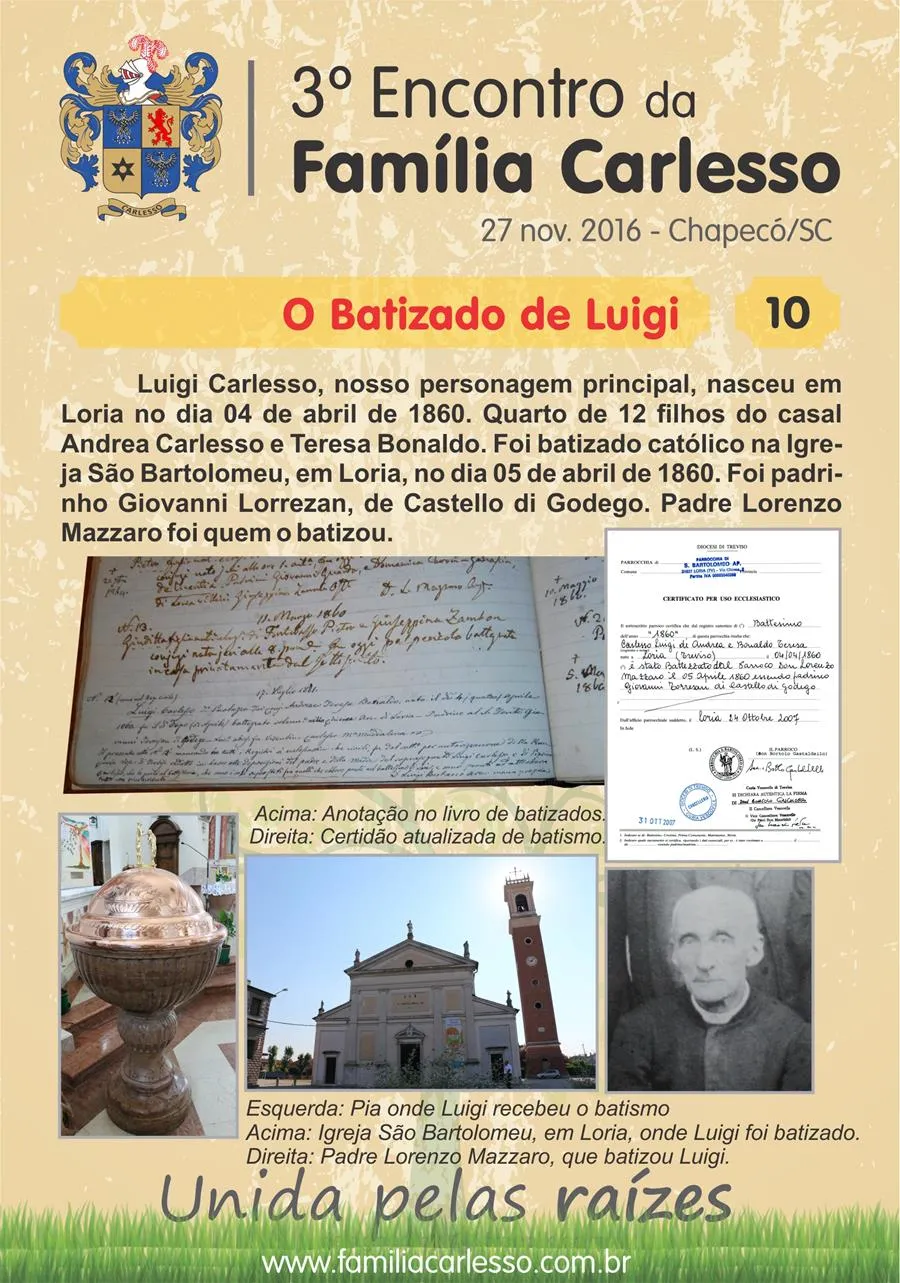
Luigi Carlesso, the central figure of this story, was born in Loria on 4 April 1860, the fourth of the twelve children of Andrea Carlesso and Teresa Bonaldo. He was baptised a Catholic in the church of San Bartolomeo, in Loria, on 5 April 1860. His godfather was Giovanni Lorrezan, of Castello di Godego. Father Lorenzo Mazzaro baptised him.
Above: the entry in the book of baptisms. Right: the updated baptism certificate. Left: the font at which Luigi was baptised. Centre: the church of San Bartolomeo, in Loria, where Luigi was baptised. Right: Father Lorenzo Mazzaro, who baptised Luigi.
11 — The bell tower of Bessica
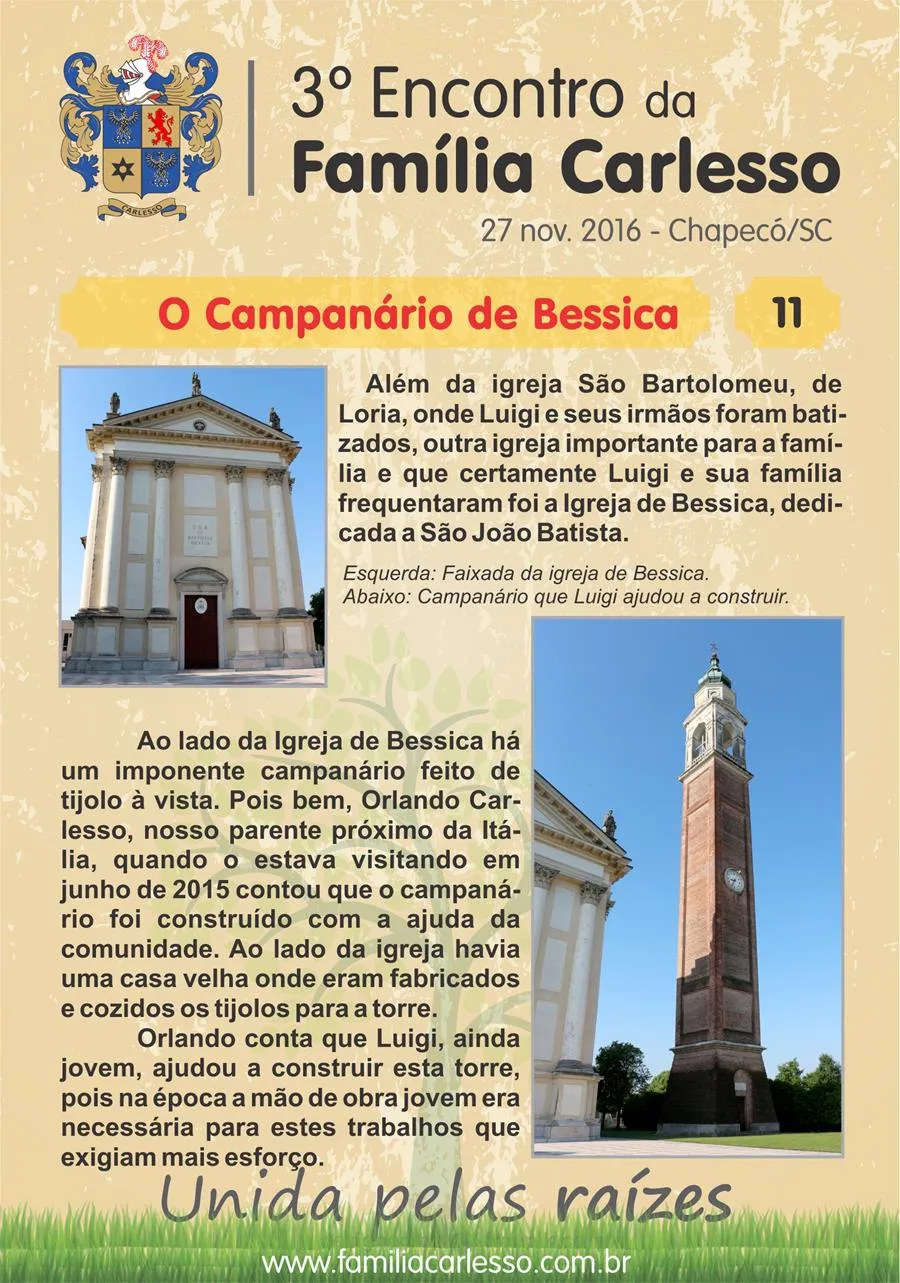
Besides the church of San Bartolomeo in Loria, where Luigi and his brothers were baptised, another church mattered to the family and was certainly attended by Luigi and his family: the church of Bessica, dedicated to San Giovanni Battista.
Left: the façade of the church of Bessica. Below: the bell tower Luigi helped to build.
Beside the church of Bessica stands an imposing bell tower of exposed brick. Orlando Carlesso, our close relative in Italy, told us during a visit in June 2015 that the tower was built with the help of the community. Next to the church stood an old house where the bricks for the tower were made and fired.
Orlando says that Luigi, still a young man, helped to build this tower, since at the time young hands were needed for work that demanded greater effort.
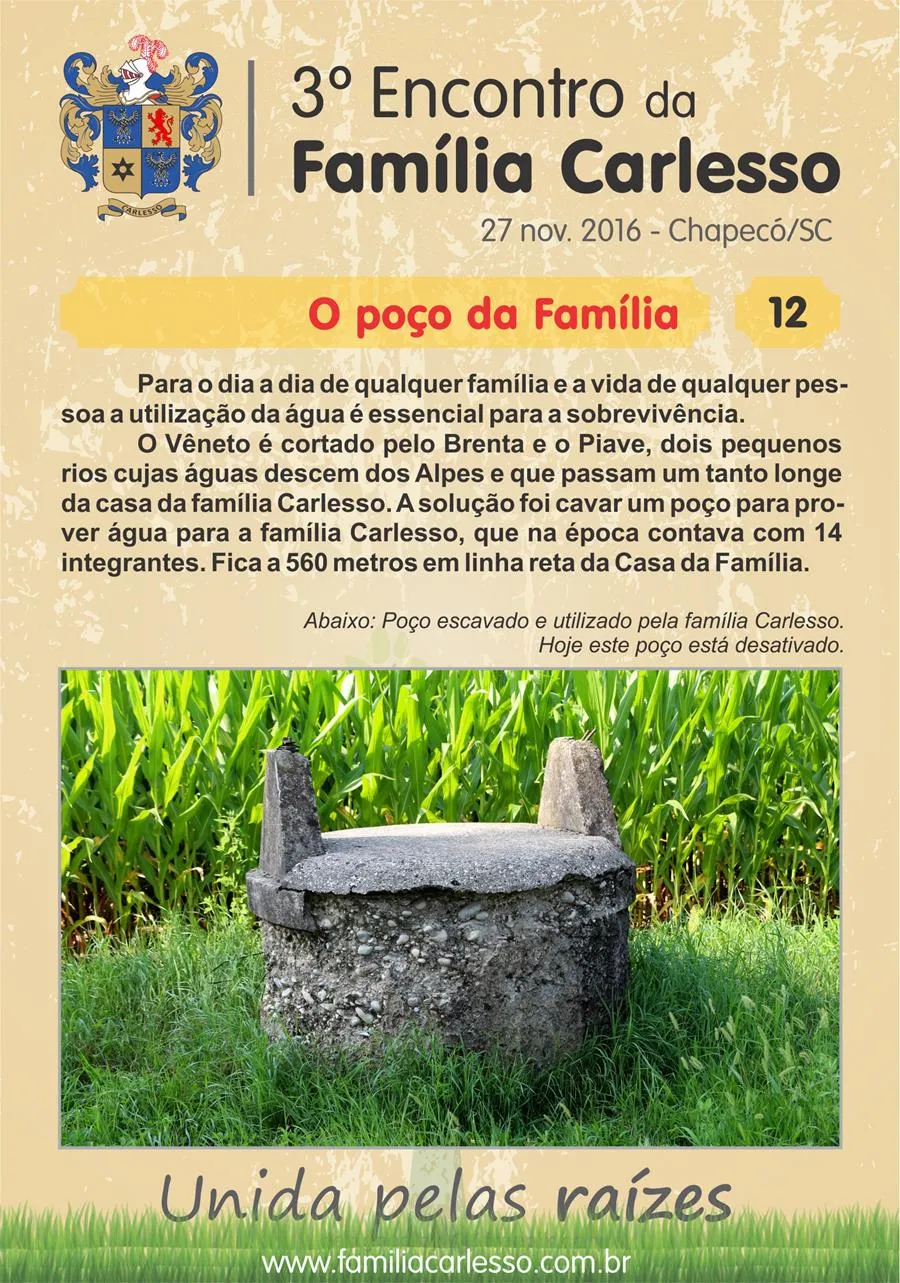
12 — The family well
For the daily life of any family, and for any person's life, water is essential.
The Veneto is crossed by the Brenta and the Piave, two small rivers whose waters come down from the Alps and which run some way from the Carlesso family house. The answer was to dig a well to supply the Carlesso family, which at the time numbered fourteen. It lies 560 metres in a straight line from the family house.
Below: the well dug and used by the Carlesso family. Today it is out of use.
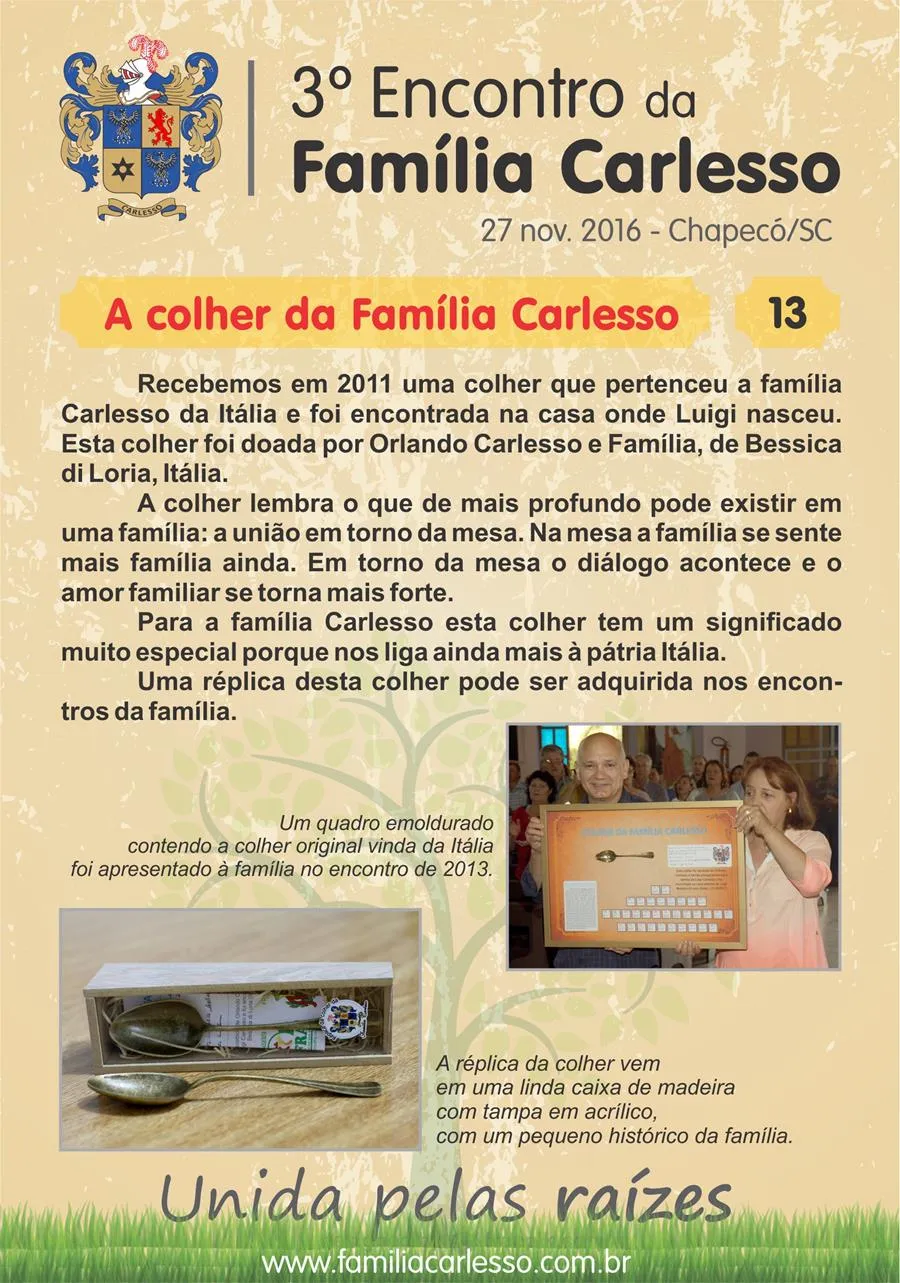
13 — The Carlesso family spoon
In 2011 we received a spoon that had belonged to the Carlesso family in Italy and was found in the house where Luigi was born. It was given by Orlando Carlesso and his family, of Bessica di Loria, Italy.
The spoon recalls the deepest thing there can be in a family: coming together around the table. At the table a family feels more like a family. Around the table conversation happens, and family love grows stronger.
For the Carlesso family this spoon has a very special meaning, because it binds us still more closely to Italy.
A replica of it can be bought at the family reunions.
A framed display holding the original spoon from Italy was presented to the family at the 2013 reunion. The replica comes in a fine wooden box with an acrylic lid, and a short history of the family.
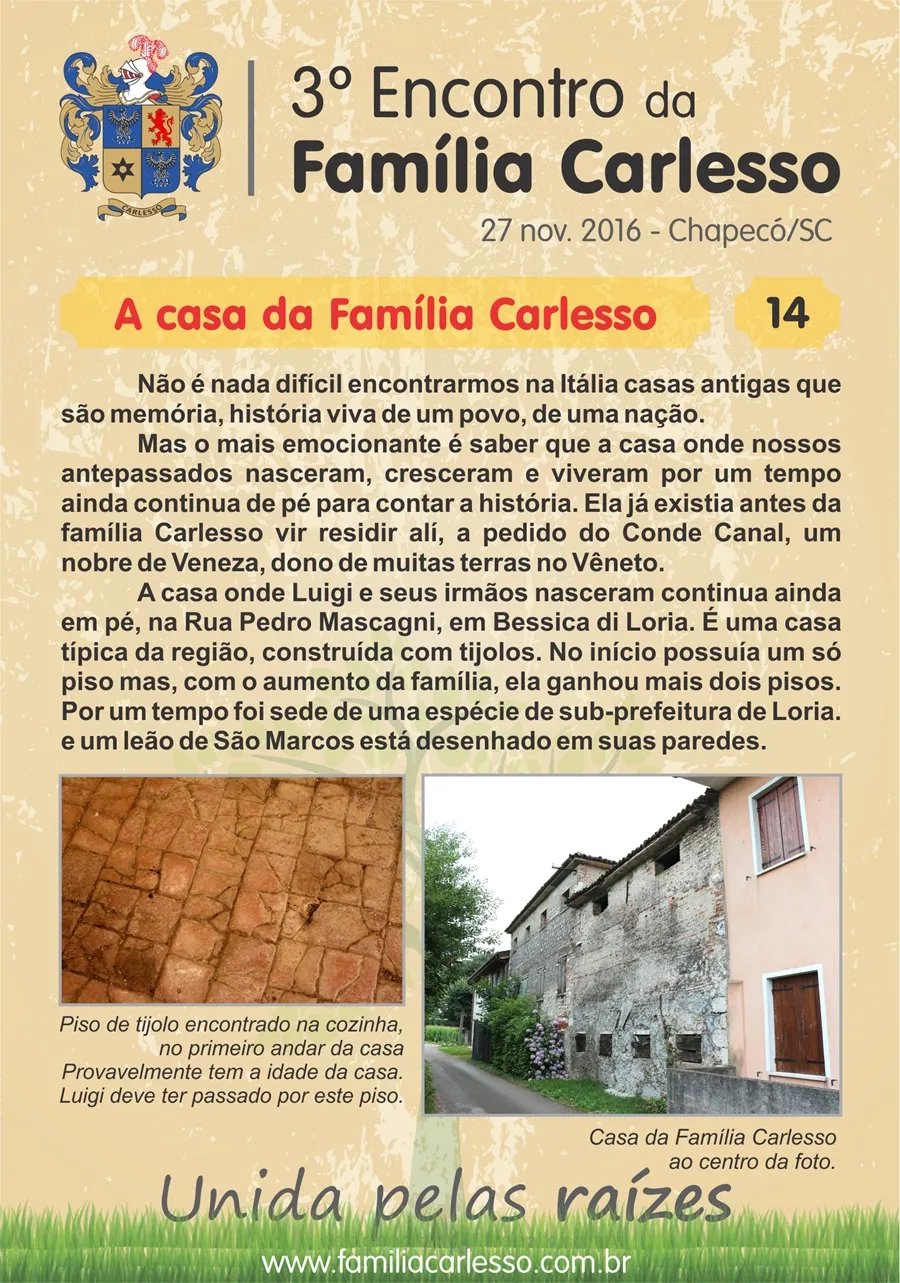
14 — The Carlesso family house
It is not hard to find old houses in Italy that are memory itself, the living history of a people and a nation.
But the most moving thing is to know that the house where our ancestors were born, grew up and lived for a time is still standing to tell the story. It was already there before the Carlesso family came to live in it, at the request of Conde Canal, a Venetian nobleman who owned much land in the Veneto.
The house where Luigi and his brothers were born still stands, on Via Pedro Mascagni, in Bessica di Loria. It is a house typical of the region, built of brick. At first it had a single floor but, as the family grew, it gained two more. For a time it housed a kind of sub-office of the comune of Loria, and a lion of St Mark is drawn on its walls.
Left: a brick floor found in the kitchen, on the ground floor of the house. It is probably as old as the house itself, and Luigi must have walked on it. Right: the Carlesso family house, at the centre of the photograph.
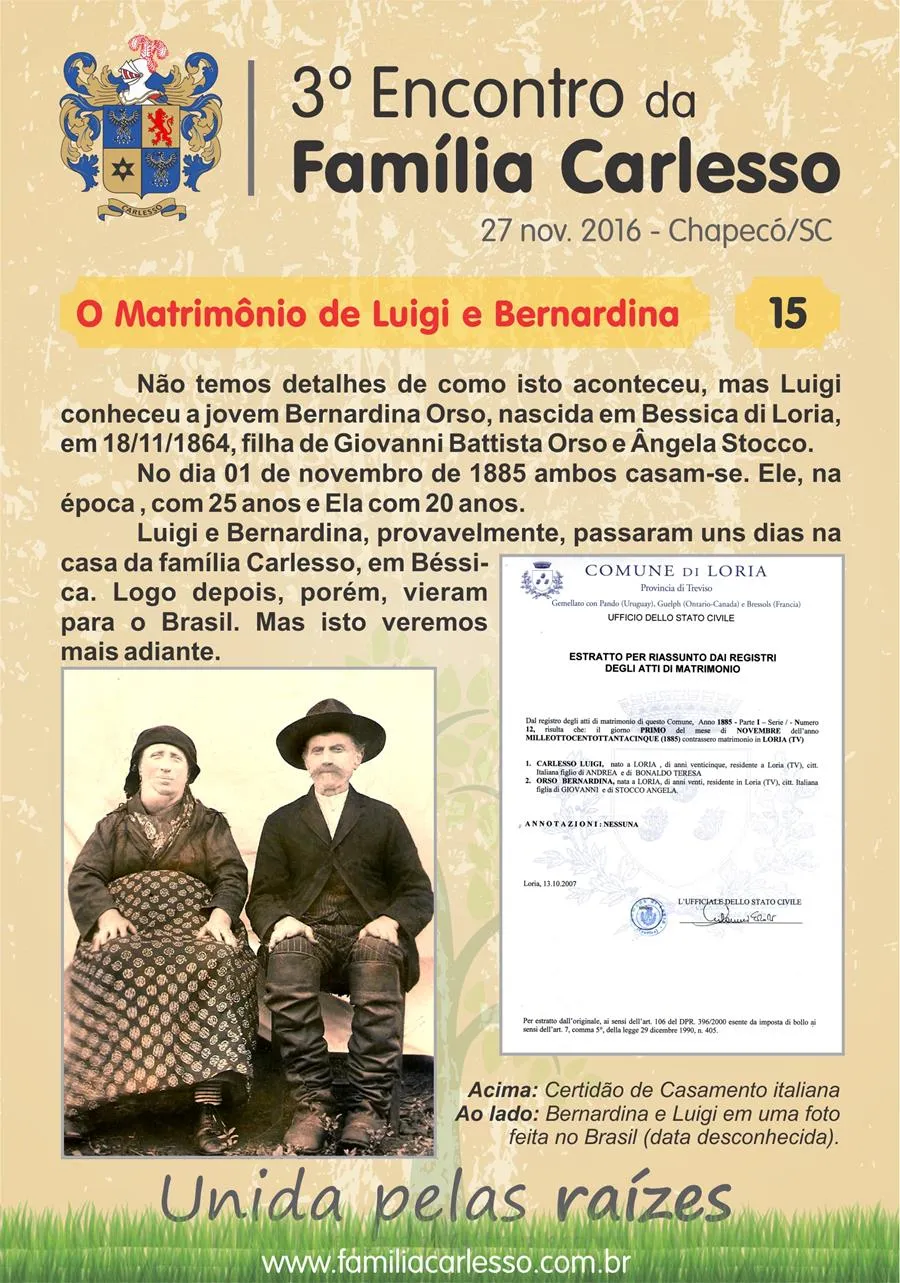
15 — The marriage of Luigi and Bernardina
We have no details of how it came about, but Luigi met young Bernardina Orso, born in Bessica di Loria on 18/11/1864, daughter of Giovanni Battista Orso and Ângela Stocco.
On 1 November 1885 the two married. He was 25 at the time, and she was 20.
Luigi and Bernardina probably spent a few days at the Carlesso family house in Bessica. Soon afterwards, though, they came to Brazil. But we shall come to that.
Above: the Italian marriage certificate. Beside it: Bernardina and Luigi in a photograph taken in Brazil (date unknown).
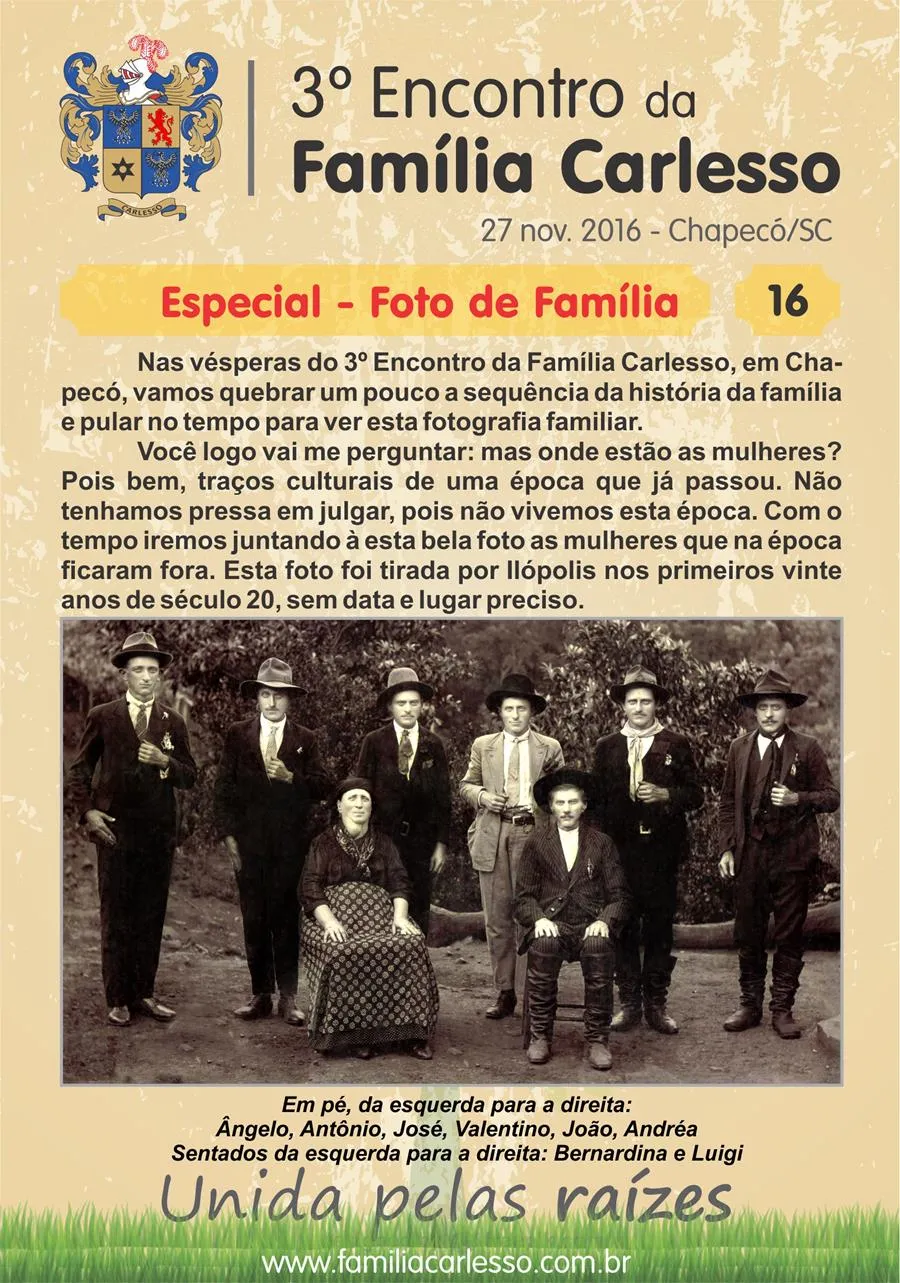
16 — Special: a family photograph
On the eve of the 3rd Carlesso Family Reunion, in Chapecó, we break the order of the family history a little and jump forward in time to look at this family photograph.
You will ask at once: but where are the women? These are the cultural traits of an age now past. Let us not be quick to judge, since we did not live in that age. In time we will add to this fine photograph the women who were left out of it. It was taken in Ilópolis in the first twenty years of the 20th century; the date and the exact place are not known.
Standing, left to right: Ângelo, Antônio, José, Valentino, João, Andréa. Seated, left to right: Bernardina and Luigi.